
This post is a reflection on the following article by Andrew Nikiforuk: “A Reality Check on our Energy Transition”
The limitations of technologically solving the energy crisis was first introduced to me in my third year at the University of British Columbia, Vancouver. While attending the first lecture of my ‘Manufacturing in Materials Engineering’ class, I distinctly remember my Professor, Dr. Steve Cockroft, asking us what we thought the future of energy looked like. Hands across the room slowly moved up and gave the answers you’d expect to hear – solar, wind, battery, etc. To our surprise, he boldly asserted we were all wrong – claiming we are quite a ways away from inventing the technology needed to power our future. This was my introduction to the importance of concepts like energy density, life cycle analysis, per capita consumption and embodied emissions. Much of the conversation around the energy transition centers on technological solutions i.e. better batteries, more efficient solar panels, advanced nuclear, green hydrogen. The implicit assumption is that innovation alone will allow us to maintain and possibly ‘improve’ upon our current lifestyle and consumption patterns while decarbonizing. However, the physics (as posited by Dr. Cockroft) and economics suggest this may be wishful thinking. The energy density, reliability, and established infrastructure of fossil fuels have enabled unprecedented levels of consumption and economic growth over the past century. As such, I believe the assumption that we can simply swap these out for renewables without any sacrifice deserves scrutiny.
Six years later, I’ve once again come across these uncomfortable realities that challenge many of the optimistic narratives we often hear. A recent (January 2025) article from the Tyee titled “A Reality Check on our Energy Transition” contends the path to a sustainable future isn’t paved with replacements for waning energy sources, but rather with a drastic reduction in our overall consumption. The argument is based on the premise that rather than a transition, our energy system evolves through a symbiotic expansion. Essentially, technological advances have allowed us to accelerate the flow of materials goods, however, the net sum of energy sources has only grown. To partly illustrate this point, Nikiforuk calls on energy analyst David Hughes, who confirms that energy derived from nuclear, hydro, solar, wind, biofuels and other renewables built since 1973 have only increased per capita energy consumption and not reduced per capita fossil fuel use.
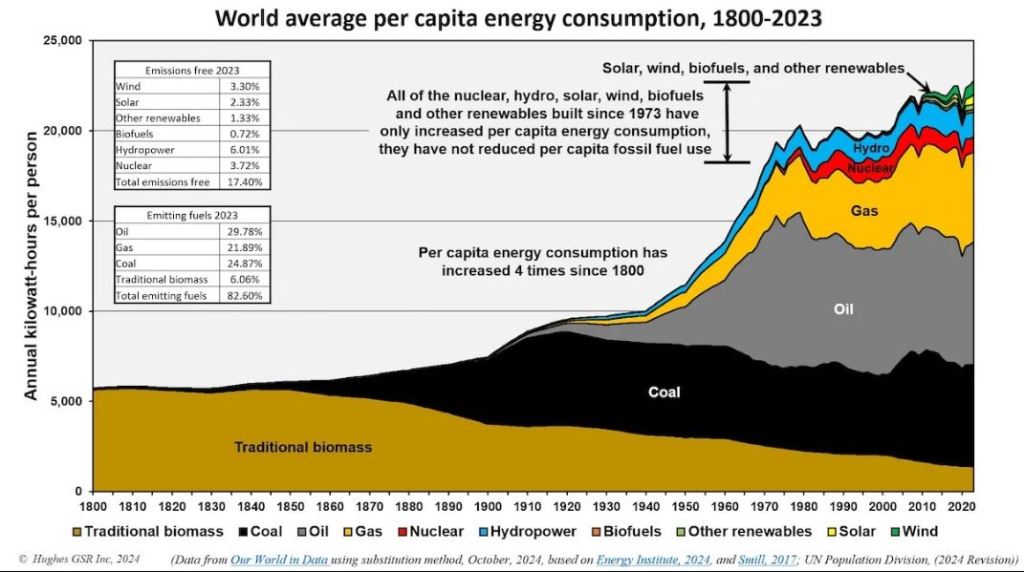
Additional research reinforces this viewpoint;
- The world currently consumes approximately 100,000 TWh of primary energy annually (with consumption increasing by 1.5% from 23′ to ’24)
- Roughly 80% of this comes from fossil fuels
- Building renewable infrastructure itself requires significant energy and resource inputs
While some might dismiss this rhetoric as overly pessimistic or categorize it as ‘doomerism’, I believe to adequately assess the energy crisis, we need an honest assessment of the challenge ahead of us. The complexity of this solution demands more than building wind farms and solar panels – it requires the largest industrial transformation in human history in a very compressed timeframe.
The ‘reality check’ levelled against the potential for a transition is necessary, however, outcomes of analogous challenges of a comparable scale (think WW2 industrial mobilization, the recovery of the ozone layer, rapid global digitalization in the past two decades) suggest there is still cause for hope. Furthermore, individually scrutinizing aspects of the energy crisis can be harmonized with broader, systems-level solutions, including circular economy principles, smart grids and demand-response technology, improving energy efficiency through retrofitting, and regenerative agriculture. Additionally, beyond scientific & economic advances, societal change in our approach to consumption is also possible. With a new generation comes a new kind of lifestyle, one that reimagines prosperity, prioritizing essential energy services over luxury and convenience uses.
In conclusion, the path forward requires a balanced approach that integrates technological innovation with meaningful behavioral change. We must embrace both the optimism that drives human ingenuity and the realism that acknowledges physical constraints. There will be uncomfortable confrontations between our energy needs and wants. However, with developing resilient local systems and redefining prosperity beyond material consumptions, we can create a future that is both sustainable and fulfilling. Within the daunting nature of the transition ahead lies an unprecedented opportunity, one that allows us to reimagine how we power our world, and more importantly, why and for what purpose.
I’m curious to hear your thoughts on this perspective! Does the idea of reduced consumption seem inevitable given the current conditions? Or do you believe technological innovation will sustain our consumptions patterns while shifting to renewable sources? Let me know in the comments below!
 lookingforenergy.blog
Leave a comment